Timeline
Figures
Terms
Timeline
Major events, publications, and case histories in the history of psychoanalysis in Russia
“In this volatile period, it is perhaps surprising to note that psychoanalysis flourished in Russia unlike any other place in the world and, what is more, survived the radical upheaval of the 1917 October Revolution.”
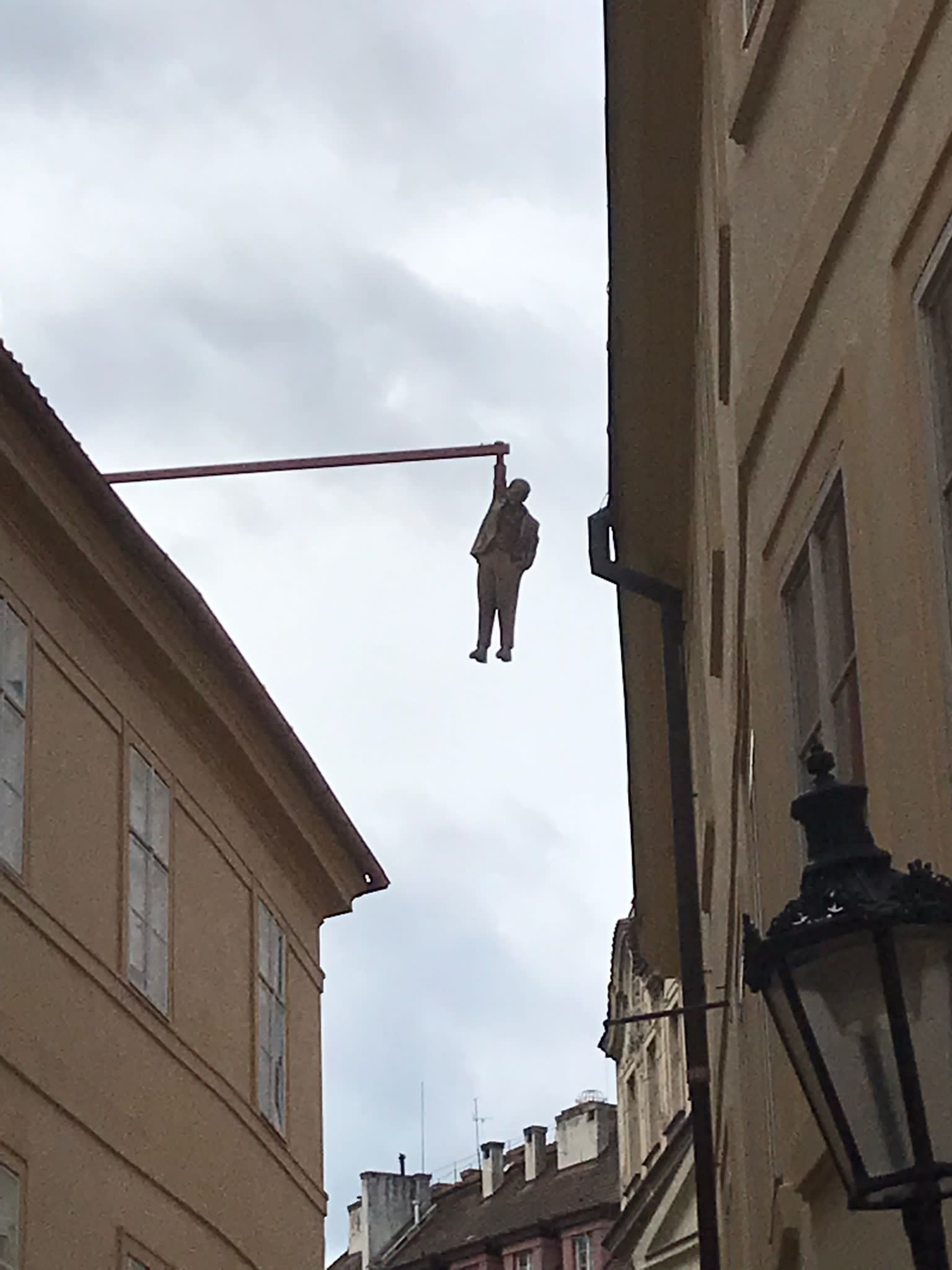
Figure 1 · David Černý, “Man Hanging Out” (1996), Prague, CzechiaPhoto credit: Anna Titov, 2023. An emblem for the dissertation: psychoanalytic thought hanging suspended between the handhold of materialism and the abyssal void below.
1899
Freud publishes Die Traumdeutung (The Interpretation of Dreams).
1904
First psychoanalytic text translated to Russian: Freud’s Über den Traum (O snovideniiakh). Pavlov wins the Nobel Prize in Physiology and Medicine for work on conditioned reflexes.
1905
Bloody Sunday; Russian Revolution of 1905; Russo-Japanese War concludes. National Conference of Psychiatrists in Kyiv supports governmental reform of mental healthcare in the zemstvos.
1907
Psychiatrists V. I. Iakovenko and V. F. Chizh publicly debate the relationship between politics and psychiatric medicine.
1908
Nikolai Osipov publishes two essays on Freud and Jung in the Zhurnal nevropatologii i psikhiatrii imeni Korsakova — the formal arrival of psychoanalysis in the Russian scientific community.
1909
N. A. Vyrubov opens the Kriukovo sanatorium outside Moscow, offering psychoanalysis and hypnosis. The Russian aristocrat Sergei Pankeev (“The Wolf Man”) begins a four-year analysis with Freud in Vienna.
1910
Osipov visits Freud in Vienna; receives permission to translate the Worcester lectures. Vyrubov, Osipov, and colleagues found the journal Psikhoterapiia. Freud writes to Jung: “In Russia there seems to be a local epidemic of psychoanalysis.”
1911
The Kasso Affair convulses higher education. Serbskii resigns from the Moscow Psychiatric Clinic; Osipov and colleagues establish the weekly circle “Small Fridays.” Tatiana Rozental’ publishes a pioneering case linking mental illness to social conditions.
1912
Ivan Il’in undergoes analysis with Freud in Vienna. Sabina Spielrein presents “Destruction as Cause of Becoming” to the Viennese Psychoanalytic Society — introducing the concept of a compulsion toward death. Emilii Metner also analyzed by Freud.
1913
Russian translation of The Interpretation of Dreams published. Goloushev publishes the case of “Gospodin Iks” in Psikhoterapiia — an early successful psychoanalytic cure of impotence rooted in a childhood trauma.
1914
Russia enters the Great War. Psikhoterapiia folds. The Freud–Jung split occurs; Metner migrates to Switzerland to collaborate with Jung.
1916
Marietta Shaginian composes Svoia sud’ba — the first Russian literary text to feature psychoanalysis as a central thematic and therapeutic concern.
1917
February and October Revolutions. The Bolshevik government decrees separation of church and state, transforming the ideological terrain of psychology. Osipov emigrates.
Soviet Period
1918
Nikolai Gumilev composes Veselye brat’ia — featuring the first psychoanalyst as protagonist in Russian literature. Decree on Separation of Church and State drafted by Mikhail Reisner.
1919
Marx-Engels Institute established in Moscow under David Riazanov — who purchases the library of Wilhelm Pappenheim, brother of Freud’s first patient (“Anna O.”). Rozental’ develops psychoanalysis at Bekhterev’s Neurological Institute in Petrograd.
1920
Freud credits Spielrein for inspiring the concept of the Todestrieb (death drive) in Beyond the Pleasure Principle.
1921
NEP period begins. Vera Schmidt, Ivan Ermakov, and Moshe Wulff oversee three state-funded institutions at the Riabushinskii Mansion: the Moscow Psychoanalytic Society, the State Psychoanalytic Institute, and the Detskii Dom-Laboratoriia “International Solidarity.” Tatiana Rozental’ dies by suicide.
1922
USSR officially established. Luria founds the Kazan’ Psychoanalytic Society. Freud’s Introductory Lectures translated to Russian — 2,000 copies sold in Moscow in a single month.
1923
Chelpanov removed from his Institute and replaced by Kornilov. Bykhovskii publishes the first major article arguing psychoanalysis is compatible with Marxist materialism. Trotsky’s letter to Pavlov urging a synthesis of reflexology and psychoanalysis published in Pravda. The Schmidts travel to Vienna and meet Freud; the Russian Psychoanalytic Society gains IPA recognition.
1924
Lenin dies (January). Second Psychoneurological Congress in Petrograd: Zalkind’s resolution to include psychoanalysis in Soviet Marxist psychology is accepted — the first state in the world to officially adopt psychoanalysis. Cosmist philosopher Aleksandr Gorskii writes Ogromnyi ocherk. Gladkov publishes Tsement.
1925
Wulff translates Freud’s Wolf Man case — the final volume in the Psychoanalytic Library. Luria and Vygotskii write a lengthy introduction to Beyond the Pleasure Principle. The International Solidarity kindergarten closes. Bulgakov writes Sobach’e serdtse; it is immediately suppressed.
1926
Sapir publishes a systematic Marxist critique of Freudian theory. Wulff’s report notes rising opposition to psychoanalysis.
1927
Voronskii dismissed from Krasnaia nov’. Voloshinov publishes Freidizm: kriticheskii ocherk — the most sophisticated Marxist linguistic critique of psychoanalysis. Luria steps down as Secretary of the Russian Psychoanalytic Society.
1928
Tynianov writes Podporuchik Kizhe. American educator John Dewey visits Soviet Russia.
1929
Trotsky exiled. Stalin announces the Great Break and First Five-Year Plan. Dialecticians defeat Mechanists in the philosophical debates. Wilhelm Reich visits Moscow for two months, defending psychoanalysis — to a cool reception.
1930
First All-Union Congress on Human Behavior: psychoanalysis officially denounced. Zalkind repudiates Freud. The Russian Psychoanalytic Society sends its final report to the IPA.
1931
Vsevolod Ivanov composes the novel Y — written “for the drawer.” Boris Vysheslavtsev publishes Etika preobrazhennogo erosa in Paris, integrating Freud and Jung into Russian Orthodox theology.
1932
All-Union Psychiatric Conference: new Pavlovian psychology proposed. Luria officially recants his Freudian interests. Stalin, at a gathering in the Riabushinskii Mansion — former home of the Moscow Psychoanalytic Institute — declares writers “engineers of human souls.”
1934
Death of Vygotskii. Socialist Realism decreed at the First Congress of Soviet Writers.
1936–38
Death of Pavlov (1936). Zalkind commits suicide. Voronskii executed in the Great Terror. Stalin publishes Dialectical and Historical Materialism (1938); the unconscious vanishes from official discourse. Freud emigrates from Vienna to London.
1948
First post-war psychiatric conference meets in strictly Pavlovian mode.
1956
Pavlov Conference meets with renewed interest in psychodynamic phenomena following Stalin’s death.
1979
Psychoanalysis openly explored at the Second International Symposium in Tbilisi — the official “return of the repressed.”
1991
Collapse of the Soviet Union. Eastern European Institute of Psychoanalysis (VEIP) established in Saint Petersburg.
Post-Soviet Period
1996
Boris Yeltsin signs a Presidential Decree allocating state funds for the development of psychoanalysis in post-Soviet Russia.
1997
Moscow Institute of Psychoanalysis established.
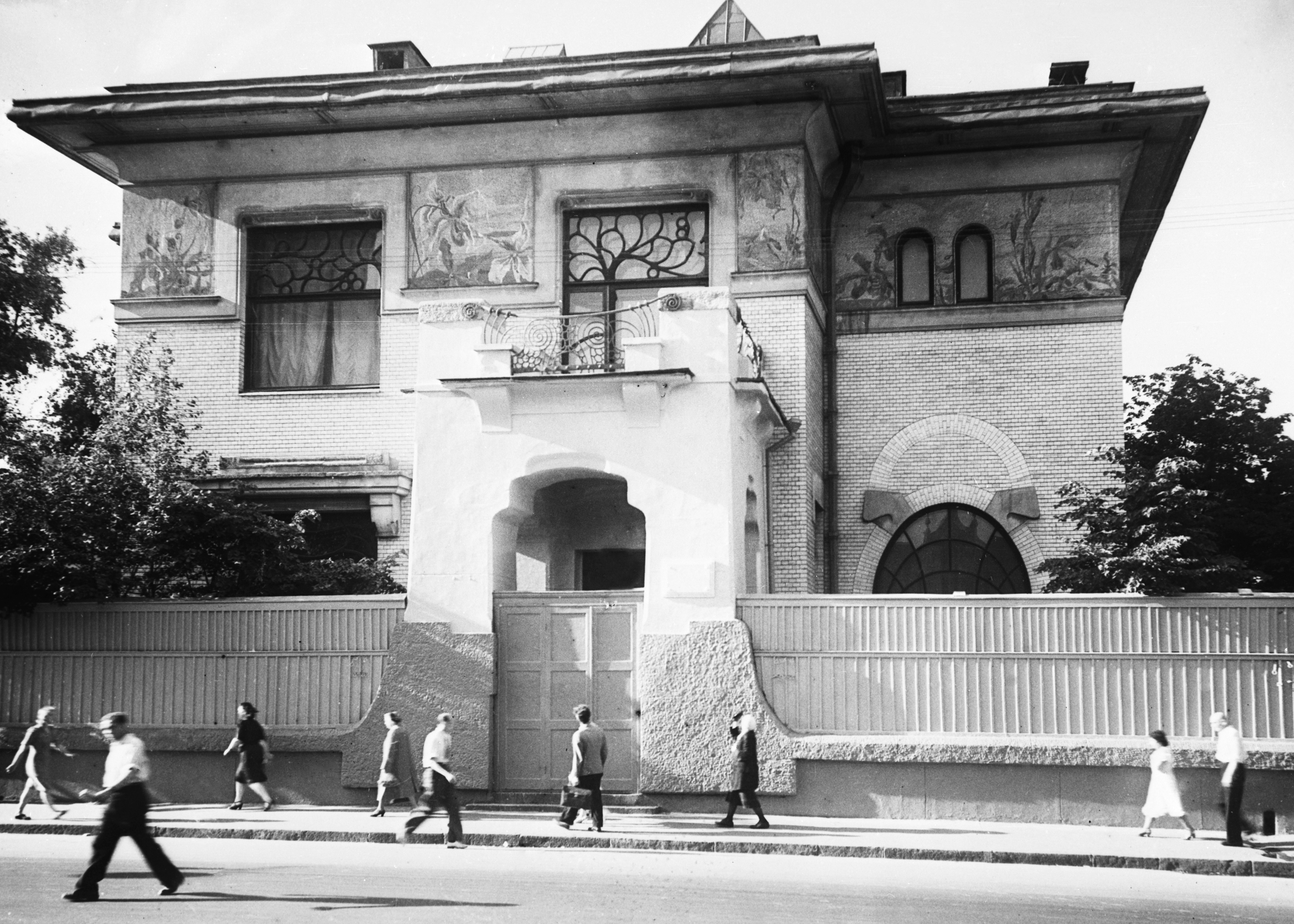
Figure 2 · The Riabushinskii Mansion during the Soviet periodFyodor Schechtel’s Art Nouveau masterpiece. From 1921–25 it held the state-sponsored psychoanalytic institute, outpatient clinic, and experimental children’s home.
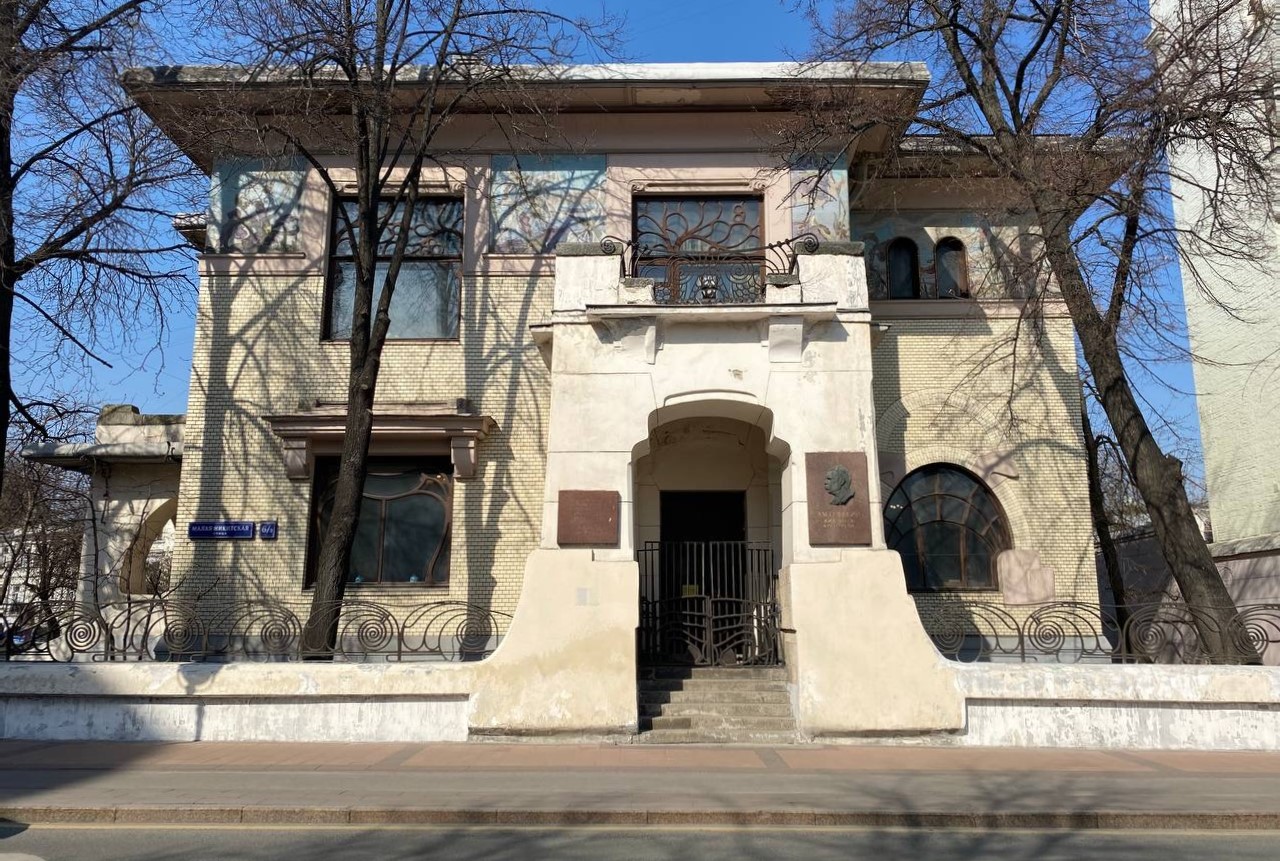
Figure 3 · The Riabushinskii Mansion, 2023Now the Gorky House-Museum, Malaia Nikitskaia Street, Moscow. Photo credit: Daria Donchenko, 2023.
Appendix A: Timeline of Psychoanalysis in Pre- and Post-Revolutionary Russia · Allgire (2023)
Key Figures
Click any name to expand. Listed alphabetically by last name.
Andreas-Salomé, Lou1861–1937Analyst / Writer
Russian-born writer, philosopher, and psychoanalyst. A confidante of Nietzsche before his illness, she met Freud in 1911 and entered his inner circle, becoming one of its most intellectually prominent members. Her presence in Freud’s circle is one of several threads linking Russian culture to the origins of psychoanalysis — alongside Spielrein and Pankeev — suggesting the particular depth of the Russian–psychoanalytic encounter.Bekhterev, Vladimir1857–1927Neurologist
Founder of Russian objective psychology and reflexology. Imported western interest in suggestion (vnushenie) and hypnosis into Russia. Developed the concept of mass suggestion to explain the 1905 Revolution. Though a rival to Freudian thought, Bykhovskii argued that Bekhterev’s reflexes were coterminous with psychoanalytic drives. His Psychoneurological Institute was ordered closed in early 1917 by a reactionary tsarist administrator.Belyi, Andrei1880–1934Writer
Leading Symbolist poet and novelist (Peterburg, Kotik Letaev); deeply immersed in Rudolf Steiner’s Anthroposophy. His bitter feud with Emilii Metner over the correct interpretation of Goethe and Kant — resulting in a 340-page polemic calling Metner an “evil animal” — indirectly drove both Metner and Shaginian toward psychoanalysis as a corrective to Symbolist mysticism. Despised psychoanalysis as a competitor to Steiner’s clairvoyant access to the supersensible world.Bulgakov, Mikhail1891–1940Writer
Physician and satirist. His novella Sobach’e serdtse (Heart of a Dog, 1925) satirizes Soviet philosophical monism and the project of creating a New Soviet Man through science. The text engages implicitly with psychoanalytic debates: Bormental’s observation of Sharikov’s “subconscious” verbal automatism, the Leibnizian gap between brain and mind, and the impossibility of localizing consciousness. The novella was immediately suppressed and not published in his lifetime.Chelpanov, Georgii1862–1936Psychologist
Founder of the Moscow Institute of Experimental Psychology (1914), modeled on Wundt’s Leipzig laboratory. A committed idealist and opponent of reductive materialism, he was abruptly removed from his own institute in 1923 and replaced by his former student Kornilov — a casualty of the philosophical debates over Marxist psychology. Appears parodied in Ivanov’s novel Y as the character Cherpanov, a psychiatrist-turned-Bolshevik recruiter.Ermakov, Ivan1875–1942Editor / Analyst
Directed the Moscow Psychoanalytic Institute’s training programs and oversaw the Psychological and Psychoanalytic Library — a state-sponsored series that translated nearly every major psychoanalytic monograph into Russian. Published psychoanalytic readings of Gogol and Pushkin. His institution occupied the Riabushinskii Mansion, the future home of Gorky.Freud, Sigmund1856–1939 · ViennaPsychoanalyst
Founder of psychoanalysis. Wrote to Jung in 1912: “In Russia there seems to be a local epidemic of psychoanalysis.” Developed his speculative “second topology” — including the death drive — partly under the influence of Russian patient Pankeev and analyst Spielrein. His concept of drives as a limit concept between the mental and the somatic became the central organizing principle of the dissertation. Emigrated from Vienna to London in 1938 with the rise of Nazism.Gorskii, Aleksandr1886–1943Philosopher
Little-known Cosmist philosopher employed at the Communist Academy of Sciences. His 1924 text Ogromnyi ocherk offers one of the most original psychoanalytic readings of the period: developing the concept of izgib (flexure) — a primordial narcissistic bend in psychical space from which drives originate and project into the world. His theory of “autoerotic reflection” anticipates Lacan’s mirror stage and prefigures post-Freudian drive theory by decades.Gumilev, Nikolai1886–1921Poet
Acmeist poet and founder of the Guild of Poets. His unfinished Veselye brat’ia (1918) features the first psychoanalyst as protagonist in Russian literature — a passive, bookish urbanite utterly powerless against the occult forces of the Russian peasantry. Had a romantic relationship with Larisa Reisner before the revolution. Executed by the Cheka in 1921 after refusing to recant public criticism of the Bolsheviks.Il’in, Ivan1883–1954Philosopher
Legal philosopher and Hegel scholar; analyzed by Freud in Vienna (1912) for suicidal ideation while completing his dissertation. Freud reportedly urged him to marry and “not despair.” Returned to Russia and briefly practiced “wild psychoanalysis,” diagnosing colleagues. Later became a hyper-reactionary nationalist and theorist of “Russian Christian Fascism.” Expelled on the Philosophers’ Ships in 1922.Ivanov, Vsevolod1895–1963Writer
Celebrated Soviet writer and member of the Serapion Brothers; mentored by Zamiatin and edited by Voronskii. His experimental novel Y (1931) — written “in one breath” on the occasion of his son’s birth — deploys psychoanalytic themes to satirize RAPP’s attacks on psychological interiority. The novel remained unpublished in his lifetime, written “for the drawer.”Jakobson, Roman1896–1982Linguist
Russian-American linguist and co-founder of the Prague Linguistic Circle. In his landmark essay on aphasia, he aligned Freud’s dream mechanisms — condensation and displacement — with the fundamental axes of language: metaphor (paradigm) and metonymy (syntagm). The dissertation uses this alignment to read Tynianov’s Kizhe and to connect Russian Formalism to psychoanalysis through the shared terrain of linguistic distortion.Kaan, Heinrich1816–1893 · ViennaPhysician
Viennese physician who served as personal doctor to Tsar Nicholas I. His Psychopathia Sexualis (1844) drew the first line between scriptural categories of sin and psychiatric categories of mental illness, linking aberrant behavior to a disturbance of the sexual instinct (nisus formativus) by the imagination (phantasia morbosa). Foucault identifies this as the founding gesture of modern psychiatry.Lunacharskii, Anatolii1875–1933Commissar
First Soviet People’s Commissar of Education (Narkompros); a philosophical Machist and “empiriomonist.” Oversaw the cultural infrastructure of the 1920s and employed figures central to the psychoanalytic milieu: Voronskii, the Schmidts, and Reisner. His essay on “god-building” (bogostroitel’stvo) reflects the same drive toward a totalizing monistic system that drew Soviet intellectuals to Freud.Luria, Alexander1902–1977Neuropsychologist
Young neuropsychologist who initially championed psychoanalysis as “rigorously monistic.” Founded the Kazan’ Psychoanalytic Society in 1922. Co-translated Freud’s Beyond the Pleasure Principle with Vygotskii. His word-association research inadvertently produced the foundations of the modern polygraph (lie-detector) test. By 1932, publicly recanted his Freudian interests under political pressure.Metner, Emilii1872–1936Philosopher
Symbolist philosopher and co-founder of the Musagetes publishing house. Analyzed by Freud in Vienna (1912) for “pseudo-Menière’s disease” rooted in his bitter feud with Andrei Belyi over Goethe and Kant. Subsequently drawn to Jung’s “analytic psychology” over Freud’s methods; moved to Switzerland and spent the rest of his life editing Russian translations of Jung’s collected works.Osipov, Nikolai1877–1934Psychiatrist
Russia’s first popularizer of psychoanalysis; published two foundational essays on Freud and Jung in 1908. Visited Freud personally in Vienna (1910) and received permission to translate his lectures. Developed a Kantian-inflected concept of the rukovodiaiushchaia tsennost’ (governing value) at the core of personality. Emigrated after 1917 and founded the Czech school of psychoanalysis in Prague.Reich, Wilhelm1897–1957Analyst
The radical Marxist in Freud’s inner circle. Visited Moscow in August–September 1929 to publicly defend psychoanalysis against Sapir’s critiques, arguing for the compatibility of Freudian drive theory with dialectical materialism. Arrived too late: Stalin’s purge of the Left Opposition had fatally tainted psychoanalysis by association with Trotsky. His books were burned by the Nazis in 1933 and by the U.S. government in 1956.Reimarus, Hermann Samuel1694–1768 · HamburgNatural Philosopher
German natural philosopher who first coined the concept of Triebe (drives) in his Drives of Animals (1760). Described ten classes and fifty-seven subclasses of animal drives; the highest was the Kunsttrieb (creative drive) — the spontaneous compulsion to generate material form. The young Marx engaged closely with Reimarus; traces of the Kunsttrieb can be found in Marx’s concept of labor power in Das Kapital.Reisner, Larisa1895–1926Journalist / Commissar
Legendary Bolshevik commissar, journalist, and beauty; studied at Bekhterev’s Psychoneurological Institute. Before the revolution, she had a creative and romantic relationship with Gumilev — possibly exposing him to Freudian ideas through her father Mikhail Reisner, who later published on Freud and religion and drafted the First Soviet Constitution. Died tragically at 30 from typhus contracted after drinking contaminated milk.Riazanov, David1870–1938Scholar / Publisher
Marxist historian and archivist; founded the Marx-Engels Institute in Moscow (1919). With 125,000 gold rubles from Lenin, purchased vast socialist library holdings in Vienna — including the collection of Wilhelm Pappenheim, younger brother of Bertha Pappenheim (“Anna O.”), Freud’s foundational “hysterical” patient. The coincidence links the archival origins of Soviet Marxism to the clinical origins of psychoanalysis.Rozental’, Tatiana?–1921Analyst
A pioneering Russian psychoanalyst who worked at Bekhterev’s Neurological Institute in Petrograd. Published a landmark 1911 case study connecting a patient’s mental illness directly to social conditions — among the first of its kind in Russia. Her work anticipated the Freudo-Marxist synthesis of the 1920s. She died by suicide in 1921, a loss mourned by the Russian psychoanalytic community.Schmidt, Otto1891–1956Scientist / Publisher
Arctic explorer and mathematician appointed by Lunacharskii as head of the State Publishing House (Gosizdat) and editor of the Great Soviet Encyclopedia. His publishing arm operated from the Riabushinskii Mansion and funded the Russian translations of nearly every major psychoanalytic work. His wife Vera Schmidt ran the psychoanalytic kindergarten in the same building. Traveled with Vera to Vienna in 1923 to meet Freud and secure IPA recognition for the Russian Psychoanalytic Society.Schmidt, Vera1889–1937Educator / Analyst
Ran the experimental psychoanalytic kindergarten International Solidarity (Mezhdunarodnaia solidarnost’) at the Riabushinskii Mansion in Moscow (1921–25). The school practiced radical non-punitive pedagogy and an open attitude toward children’s sexuality — controversies that led to its closure. Traveled to Vienna with her husband Otto in 1923 to meet Freud and the IPA leadership.Shaginian, Marietta1888–1982Writer
Armenian-Russian author; composed Svoia sud’ba (1916) — the first Russian novel to place psychoanalysis at the center of its plot and therapeutic method. Her close contacts with Metner, Il’in, and Belyi exposed her to psychoanalytic thinking at the moment of Symbolism’s breakup. Later converted to Marxism; the 1954 edition of her novel extensively revised to denounce “Freudianism.”Shklovskii, Viktor1893–1984Critic / Theorist
Co-founder of Russian Formalism and author of the foundational essay “Art as Device.” Though Formalism officially evacuated psychology from literary analysis, Shklovskii’s own writing reveals persistent psychoanalytic proximity: his concept of automatization echoes Freud’s pleasure principle; his Sentimental Journey declares, “I am no socialist, I am a Freudian.”Spielrein, Sabina1885–1942 · Rostov-on-DonPsychoanalyst
Russian-Jewish psychoanalyst, former patient of Jung, and member of the Viennese circle. In 1912 she presented “Destruction as Cause of Becoming” — introducing the concept of a compulsion toward death (vlechenie k smerti) that Freud would develop into the death drive in 1920. Returned to Soviet Russia in 1923; directed the International Solidarity kindergarten with Vera Schmidt. Murdered by the Nazis in 1942.Trotsky, Leon1879–1940Politician
Bolshevik leader and the most prominent political supporter of psychoanalysis within the Soviet state. In a 1923 letter to Pavlov published in Pravda, he compared the psyche to a well and urged combining Pavlovian reflexes with Freudian drives. His patronage secured institutional support for the Russian Psychoanalytic Society. Exiled in 1929; assassinated in Mexico City in 1940.Tynianov, Yuri1894–1943Writer / Theorist
Russian Formalist critic and historical novelist. His novella Podporuchik Kizhe (1928) — in which a scribal error generates a fictitious officer with a full military career — is read in the dissertation as an implicit engagement with psychoanalysis: slips of the pen, Oedipal tensions, Eros as thematic through-line, and the “onomastic drive” of a name that compels action without a person.Voloshinov, Valentin1895–1936Linguist
Member of the Bakhtin circle; wrote the most sophisticated Marxist critique of psychoanalysis: Freidizm: kriticheskii ocherk (1927). Argued that the unconscious is not an interior psychological reality but an interiorized product of social language and dialogue. His book was productively shaped by the psychoanalytic theory it critiqued; some scholars see it as a precursor to Lacanian discourse theory.Voronskii, Aleksandr1884–1937Literary Critic
Editor of the thick journal Krasnaia nov’; close associate of Trotsky. Utilized psychoanalytic concepts — including the dynamic unconscious — to develop his theory of artistic creativity: “Art is the cognition of life.” Published first post-revolutionary articles on psychoanalysis for a lay public. Joined the Left Opposition; fired from his editorship in 1927; executed during the Great Terror.Vygotskii, Lev1896–1934Psychologist
Pioneering developmental psychologist and close collaborator of Luria. Co-translated Freud’s Beyond the Pleasure Principle into Russian (1925) with a lengthy introduction. In his 1927 manuscript The Historical Meaning of the Crisis in Psychology, argued that pathology — not the norm — holds the key to understanding the mind, and that psychoanalysis revealed this most clearly. Died of tuberculosis at 37.Vysheslavtsev, Boris1877–1954Philosopher
Religious philosopher expelled from Soviet Russia in 1922 on the “Philosophers’ Ships.” In Paris, made the “Christianization of Freud” virtually his life’s project — recasting psychoanalytic sublimation in terms of Orthodox theology and Jungian individuation. His Etika preobrazhennogo erosa (1931) posits an “erotic drive” (erotiko-tendiruiushchee vlechenie) at the root of all higher creativity.Wulff, Moshe1878–1971Analyst / Translator
Directed the Moscow Psychoanalytic Society’s outpatient clinic. Translated Freud’s Wolf Man case into Russian as the final volume of the Psychoanalytic Library (1925) — after which the series was abruptly cancelled. Reported on the rising tide of opposition to psychoanalysis to the IPA in 1926.Zalkind, Aron1888–1936Psychologist
Radical Marxist psychologist who in 1924 successfully motioned at the Second Psychoneurological Congress to include refleksologirovannyi freidizm in Soviet psychology — the first official state adoption of psychoanalysis in history. By 1930, publicly denounced Freud as oriented toward the past. Founded the field of Pedology; committed suicide in 1936 after the Central Committee attacked his work.
Figures drawn from chapters throughout The Anatomy of the Drives · Allgire (2023)
Key Terms
Click any term to expand. Central concepts in the intellectual history of psychoanalysis in Russia, 1905–1930 — listed alphabetically.
AbyssRussian: bezdna (бездна)
A widespread Symbolist metaphor derived from Schelling’s concept of the Ungrund — signifying the unknown depths of the soul, the unconscious, and the erotic-creative wellspring. In Silver Age culture, figures like Solov’ev, Berdyaev, and Rozanov associated the abyss with sexuality and the “sexual question.” The dissertation opens with the image of Freud’s Prague statue hanging suspended above it: psychoanalytic thought maintaining a precarious handhold on material reality over the abyssal void below.AfterwardnessGerman: Nachträglichkeit
Freud’s concept developed in the Wolf Man case: traumatic events do not “register” in consciousness at the moment they occur, but acquire meaning only retroactively — after a subsequent event triggers their symbolic significance. Freud developed this concept partly through his four-year analysis of the Russian aristocrat Sergei Pankeev. The concept implies that the past is never simply past, but is always being rewritten from the position of the present — a deeply anti-mechanist idea.Autogenetic MovementRussian: avtogeneticheskoe dvizhenie · Dialectician philosophers, 1920s
The Dialecticians’ answer to the Mechanists: consciousness, though arising from the physiological substrate, operates according to qualitatively distinct laws of “self-movement” — it cannot be fully reduced to reflexes or physical chemistry. The concept justified psychology as an independent discipline and was used to defend the irreducibility of the psyche. The dissertation links it to the Freudian unconscious as a site of comparable “autogenetic” productivity.BildungstriebGerman: “formative drive” · coined by Johann Friedrich Blumenbach (1781)
A life force compelling the organism to unfold toward a predetermined form or plan (Bild). Embraced by Goethe; provisionally accepted then cautiously qualified by Kant, who warned against attributing a conscious “plan” to nature. Central to the breakup of Russian Symbolism: the Metner–Belyi feud over whether Goethe accepted Kant’s restriction of the Bildungstrieb as a heuristic (Metner’s view) or transcended it through clairvoyance (Steiner/Belyi’s view).CatharsisGreek: katharsis · Aristotle; revived by Breuer and Freud
The therapeutic release achieved through the psychoanalytic “talking cure”: by recalling a repressed memory and putting it into language, the patient becomes liberated from an unconsciously held belief that had manifested as a physical or behavioral symptom. The case of “Gospodin Iks” in the journal Psikhoterapiia (1913) — the earliest published psychoanalytic case study in Russia — illustrates catharsis enacted through the recovery of a childhood trauma.CondensationGerman: Verdichtung
One of the two primary mechanisms of the dreamwork (alongside displacement): the compression of multiple ideas, images, or figures into a single composite element. Jakobson aligned condensation with the metaphoric/paradigmatic axis of language, creating a bridge between psychoanalysis and linguistics central to the dissertation’s final chapter on Tynianov and Russian Formalism.Death DriveGerman: Todestrieb · Russian: vlechenie k smerti
A speculative concept introduced by Freud in Beyond the Pleasure Principle (1920), describing an underlying compulsion toward dissolution, repetition of trauma, and a return to an inorganic state. The dissertation argues that the concept originates with Sabina Spielrein’s 1912 paper “Destruction as Cause of Becoming.” Freud, who initially rejected the idea, later credited her. The death drive marks the end of Freud’s early biological phase and the beginning of his speculative second topology.DisplacementGerman: Verschiebung
The second primary mechanism of the dreamwork: the transfer of psychical intensity from one idea to another, apparently trivial, element — so that what seems most significant in a dream may be peripheral, while the truly charged content hides in a marginal detail. Jakobson aligned displacement with the metonymic/syntagmatic axis of language. Together, condensation and displacement are the two engines through which unconscious drives find expression in dreams, slips, and literary form.DrivesGerman: Triebe · Russian: vlechenie (влечение) · also rendered as “instinct” or “impulse”
The central organizing concept of the dissertation. For Freud, drives are a limit concept situated at the frontier between the mental and the somatic — neither purely biological instinct nor purely psychological idea. They exert a constant pressure on the psyche without ever being directly accessible to consciousness.“Its concept of drive is rigorously monistic… Drive is not a psychological phenomenon in the strict sense, since it includes the effects of somatic and nervous stimuli and of the endocrine system and its chemistry.” — Luria (1925)The dissertation traces the concept from its origins in Reimarus, through Schiller, Blumenbach, Kaan, and Marx, to its apotheosis in psychoanalysis and its reception in Soviet intellectual life.DushaRussian: “soul” (also: “psyche,” “spirit”) · душа
The contested Russian word at the center of debates over materialism, psychology, and religion. Where German could distinguish Seele (soul) from Geist (spirit) and Psyche (psyche), Russian collapsed all three into dusha — a term resonating with Orthodox theology as much as with secular science. The 1867 controversy over Wundt’s Vorlesungen — where the translator rendered Seele as dusha — illustrates how fraught the language of psychology was in Russia: to speak of the “soul” scientifically risked sacrilege; to evacuate it risked nihilism.Empiriomonismcoined by Alexander Bogdanov, c. 1904–1906
The philosophical system developed by Alexander Bogdanov, combining Ernst Mach’s empiriocriticism with a monistic framework. Attacked by Lenin in Materialism and Empiriocriticism (1909). Central to the 1920s debates over the philosophical foundations of Soviet psychology; the “empiriomonist” Lunacharskii sought a system capable of unifying science, art, and politics under a single explanatory principle — the same totalizing ambition that drew Soviet intellectuals to Freud.Free AssociationGerman: freie Einfall · the “fundamental rule” of psychoanalysis
The foundational technique of psychoanalysis: the patient recounts whatever comes to mind without censorship, allowing repressed material to surface through the gaps and distortions of speech. Satirized in Shaginian’s Svoia sud’ba as “lying on the couch and associating aloud while the doctor writes everything down.” Zamiatin compared the creative process of artistic composition to free association — a sustained attitude of play between consciousness and unconscious material, like a switch set to the “blue light” between sleep and waking.Freudo-MarxismRussian: Freido-marksizm
The 1920s project — associated with Luria, Bykhovskii, Reisner, Zalkind, and others — of reconciling Freudian drive theory with Marxist materialism. Its proponents argued that psychoanalysis was “rigorously monistic,” dialectical, and materialist; that the concept of drives was coterminous with Pavlovian reflexes; and that psychoanalysis could supply the individual psychological dimension missing from Marxism’s social theory. By 1930, the project was officially denounced.God-buildingRussian: bogostroitel’stvo · Lunacharskii, Gorky, c. 1905–1920
A Bolshevik cultural project associated with Lunacharskii and Gorky, seeking to replace religious feeling with a secular, socialist equivalent — a “new mythology” grounded in labor, revolutionary history, and scientific materialism. The dissertation reads this as sharing the same drive toward totalizing monism that drew Soviet intellectuals to Freud: both projects sought a unified account of human motivation capable of replacing the discredited authority of the Church.IdGerman: das Es (“the It”) · Freud’s second topology, 1923
Freud’s second-topology term for the reservoir of unconscious drives — the impersonal “it” that precedes and exceeds conscious ego formation. In Shaginian’s novel, the concept of lichnost’ (personality) performs a similar function: an opaque, instinctual core compelling the subject from within, contrasted with the more visible kharakter (character) oriented toward the external world. The relationship between lichnost’ and kharakter maps loosely onto the Id/Ego distinction.IzgibRussian: “flexure,” “torsion,” “bend” · Aleksandr Gorskii, Ogromnyi ocherk (1924)
Gorskii’s unique speculative concept: a primordial narcissistic “flexure” in psychical space — the point from which the drives originate and project outward, finding resonance in the other and generating erotic attraction and artistic inspiration. Gorskii illustrates it with Dmitri Karamazov’s sudden fixation on the specific curve of Grushenka’s body. The izgib is what can be glimpsed in an author’s style — distributed across their entire work as an unconscious signature. The concept anticipates Lacan’s theory of the subject receiving its own message in an inverted form.KunsttriebGerman: “skillful drive” or “creative drive” · Reimarus (1760)
The highest of Reimarus’s fifty-seven subclasses of animal drives — the spontaneous, instinctual capacity of bees, spiders, and other creatures to generate material forms without prior instruction. The dissertation argues that Reimarus’s Kunsttrieb entered Marx’s early thought via his dissertation research on Epicurus, leaving traces in the concept of “productive forces” (proizvoditel’nye sily) in Das Kapital. Gleb’s compulsive, plan-less drive to restart the cement factory in Gladkov’s Tsement is read as its literary embodiment.LibidoLatin: “desire” · Freud’s term for the energy of the sexual drives
Freud’s term for the psychical energy of the sexual drives — the force that attaches to objects, undergoes repression, sublimation, and displacement. Central to the Freudo-Marxist debates: Zalkind attempted to “reflexologize” libidinal energy by identifying it with Pavlovian excitation. Voronskii used a secularized concept of libidinal attachment to theorize the artist’s intuitive, sensuous relationship to reality. Maiakovskii satirized it in Klop as a disease of bourgeois individualism.Mechanist ControversySoviet philosophical debates, 1920s
The 1920s Soviet philosophical debate between the Mechanists (who reduced consciousness to physical and chemical processes) and the Dialecticians (who defended the irreducibility of the psyche to physiology). Psychoanalysis was caught in the crossfire: initially welcomed by both camps as materialist, it was ultimately rejected as incompatible with either position. The controversy ended with Stalin’s intervention, which dissolved both schools and imposed a simplified “dialectical materialism” as the official philosophical framework.MonismGreek: monos, “single” · a recurring ambition in Russian and Soviet intellectual life
The philosophical goal of explaining all reality — mental and physical, individual and social — through a single unified principle. Expressed in the Symbolist search for sobornost’, the Bolshevik project of dialectical materialism, and the Freudo-Marxists’ attempt to reconcile drives with reflexes. Bulgakov’s Heart of a Dog satirizes the monist dream of producing a unified New Soviet Man from a dog — only for the experiment to generate an irreducible social contradiction that cannot be sutured by any surgical thread, however amber-colored.Nisus FormativusLatin: “formative striving” · Kaan (1844), after Blumenbach
Kaan’s term for the sexual drive as a foundational force linking the body to the mind. When the nisus formativus is disturbed by a pathological imagination (phantasia morbosa), mental illness results. Kaan’s innovation — linking mental illness to psychology rather than anatomy — founded the “psychogenic paradigm” that led directly to hypnosis, and then to psychoanalysis. As personal physician to Tsar Nicholas I, Kaan developed these ideas during his years in Russia.Onomastic DriveFrom Greek onoma (name) · a term developed in the dissertation
The concept — emerging from the reading of Tynianov’s Podporuchik Kizhe — that proper names possess a sonic and mythological force capable of generating action, character, and narrative without reference to a real person. Drawing on Lotman and Uspenskii’s account of “mythological thinking” (where the name is the thing) and on Jakobson’s alignment of Freudian condensation and displacement with the linguistic axes of metaphor and metonymy.PedologyRussian: pedologiia · founded by Aron Zalkind, 1920s
The Soviet educational science founded by Zalkind, combining developmental psychology, reflexology, and elements of psychoanalytic theory to study and optimize the psychological development of children. Officially condemned and dissolved by the Central Committee in 1936; Zalkind committed suicide shortly after receiving the decree. Pedology is one of three sciences — alongside genetics and cybernetics — that were suppressed in the Soviet period and later rehabilitated.Phantasia MorbosaLatin: “morbid fantasy” · Kaan (1844)
Kaan’s term for the pathological overproduction of imagination that overwhelms the will. When fantasy exceeds its proper bounds, it takes over the subject’s behavior — producing sexual perversion, hysteria, or compulsive repetition. The concept appears throughout the literary readings in the dissertation: Mitia’s hypnotic suggestion over Masha in Gumilev’s Veselye brat’ia, Gleb’s eroticized fantasy of the cement factory in Gladkov’s Tsement, and Preobrazhenskii’s quasi-religious fixation on the dog’s pituitary gland in Bulgakov’s Heart of a Dog.Psychogenic Paradigmcoined by Robert Sommer (1894); built on Kaan, Tuke, Bernheim, Charcot
The principle that mental illness — rather than arising from physical lesions — could be produced by the imagination (Vorstellung) and therefore treated by the imagination. Traced in the dissertation from Kaan’s Psychopathia Sexualis (1844) through the Nancy and Salpêtrière schools of hypnosis to psychoanalysis: mental illness as “all in the head” — yet with real, material effects that elude the surgeon’s scalpel.ReflexPavlov and Bekhterev · Russian objective psychology, late 19th–early 20th c.
The foundational concept of Pavlovian and Bekhterevian psychology: a stimulus-response arc in the nervous system, either innate (unconditioned) or acquired through repetition (conditioned). The Freudo-Marxists argued that the psychoanalytic drive was coterminous with the reflex — a claim fiercely contested by both sides. Trotsky proposed combining the two systems in his 1923 letter to Pavlov, using the metaphor of a deep well: Freudians look down from above, Pavlov works upward from below, and one day they must meet in the middle.ReflexologyVladimir Bekhterev · Obshchie osnovy refleksologii cheloveka (1917)
Bekhterev’s system of objective psychology, which sought to explain all human behavior — including higher cognitive and emotional functions — through the mechanics of neural reflexes, without reference to subjective experience. The most prominent Russian competitor to psychoanalysis in the 1920s, and the system with which Freudo-Marxists most often sought to reconcile Freudian theory. Bykhovskii argued that Freud’s concept of the ego was equivalent to Bekhterev’s “personal complex of correlative reflexes.”RepressionGerman: Verdrängung
The psychoanalytic mechanism by which unacceptable ideas, desires, or memories are excluded from consciousness and consigned to the unconscious, where they continue to exert pressure — emerging in symptoms, dreams, slips of the tongue, and compulsive repetitions. Voloshinov critiqued repression as an idealist fiction, arguing that what Freud called “the unconscious” was in fact the product of social censorship internalized through language. In a structural irony, the concept of repression is itself deployed throughout the dissertation to describe the Soviet suppression of psychoanalysis — and its eventual “return” at the 1979 Tbilisi symposium.Silver AgeRussian: Serebrianyi vek · approx. 1890–1917
The Russian cultural period characterized by an unprecedented flowering in poetry, philosophy, and religious thought. Marked by profound crises of faith, radical experiments in living, and an obsession with the “sexual question.” The period’s intense psychologism — its preoccupation with interior life, fate, and the abyss — created the cultural conditions for psychoanalysis’s enthusiastic Russian reception. Gorky famously called the decade 1907–1917 “the most shameless and shameful decade in the history of the Russian intelligentsia.”Sobornost’Russian: “spiritual community” or “conciliarity”; from sobor (cathedral, council)
A Russian concept describing the organic unity of a community in shared faith and purpose. In the dissertation, it names a broader Russian intellectual tendency toward maximalist synthesis: a desire for a single, totalizing system (monizm) capable of explaining all of reality. This drive toward sobornost’ shaped the reception of psychoanalysis in both its Symbolist and its Soviet-Marxist phases: Freud’s theory was appealing precisely because it seemed to offer a unified model of the human subject.SpieltriebGerman: “play drive” · Friedrich Schiller, Letters on the Aesthetic Education of Man (1795)
Schiller’s synthesis of two opposing drives: Stofftrieb (the sensuous drive, registering the physical world) and Formtrieb (the formal drive, organizing sense-data into meaningful patterns). Their dialectical harmony produces the Spieltrieb — a vital impulse of creativity and play that operates within necessary rules without being reducible to them. Schiller’s is the most prominent pre-psychoanalytic account of the drives in the German tradition, and his massive influence on Russian literature (Dostoevsky, Pushkin, Tolstoy) made him a key background figure for the dissertation’s argument.Spontaneity / Consciousness ParadigmRussian: stikhiinost’ / soznatel’nost’ · Lenin, What Is to Be Done? (1902)
Lenin’s foundational binary: the working class, left to itself, achieves only “spontaneous” trade-union consciousness; only the theoretically guided vanguard party can supply full “consciousness.” The paradigm became the master plot of Socialist Realism (per Katerina Clark) but the dissertation complicates it — drawing on Anna Krylova’s argument that Lenin himself, after 1905, made room for “class instinct” as a creative and purposeful spontaneous force. The drives, the dissertation argues, are what the binary represses.SublimationGerman: Sublimierung
The psychoanalytic process by which instinctual, sexual energy is redirected toward higher cultural aims — art, science, philosophy, religion. In the Russian context, Boris Vysheslavtsev made the concept foundational to his theology: sublimation, properly understood, is the process by which erotic energy is transformed into creative and ultimately spiritual activity. Voronskii used a secular version of the same concept to argue that art cognizes life through a “sensual” form of intuition.SuggestionRussian: vnushenie · imported by Bekhterev from Charcot’s Salpêtrière school
The mechanism by which one psyche influences another below the threshold of conscious awareness — the foundational concept of hypnosis, imported into Russia by Bekhterev after studying with Charcot. Bekhterev extended suggestion from the clinical dyad to mass psychology, using it to explain crowd behavior and revolutionary phenomena. Psychoanalysis emerged historically out of the failure of suggestion and hypnosis as therapeutic techniques; Freud’s abandonment of hypnosis in favor of free association marks the founding gesture of the discipline.TransferenceGerman: Übertragung
The psychoanalytic concept describing the patient’s unconscious redirection onto the analyst of emotions, desires, and conflicts originating in earlier relationships. The clinical heart of psychoanalytic technique. In the dissertation’s reading of Ivanov’s Y, the analyst Andreishin’s unacknowledged erotic attachment to the prostitute Susanna is read as a comic reversal: the analyst succumbs to his own unanalyzed transference, a chamber pot overturned on his head serving as the text’s literal emblem of psychic dirt returning to its source.UnconsciousRussian: bessoznatel’noe (бессознательное) · term coined by Schelling (1800)
The portion of the psyche inaccessible to direct introspection, yet exerting constant pressure on conscious life through dreams, slips, symptoms, and artistic production. The concept’s Soviet fate is a central thread of the dissertation: officially adopted in 1924, officially denounced by 1930, officially “returned” in 1979 at the Tbilisi symposium. Voloshinov argued it was a mystification; Gorskii saw it as the site of the izgib and the source of artistic inspiration; Vygotskii held that pathology — not the norm — revealed its operations most clearly.
Terms drawn from The Anatomy of the Drives · Nikita Allgire · USC Graduate School · 2023

 Nikita Allgire